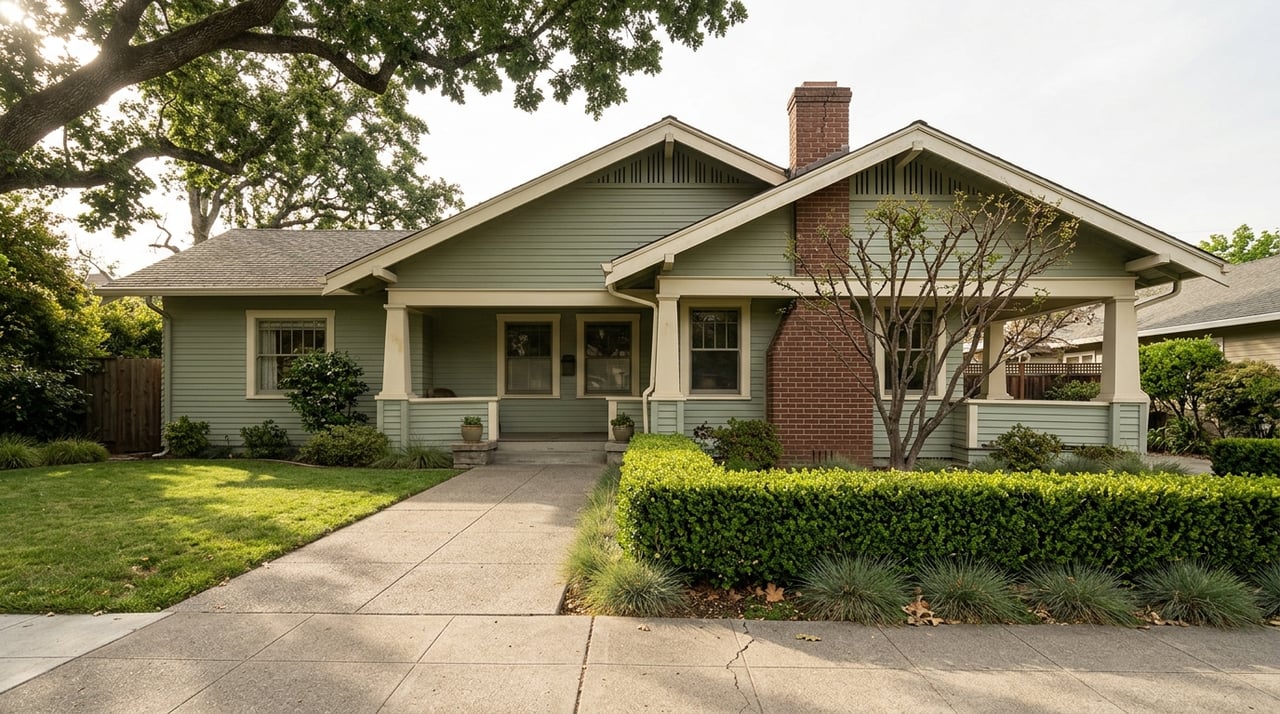
Most sellers of an older Petaluma home make the same list before they call an agent. Refinish the fir floors. Patch the plaster. Maybe get a bid on rewiring if the inspector is going to flag it anyway. It is a reasonable list, and it is aimed at the wrong clock.
The delay that actually stalls these listings rarely starts with a contractor. It starts with a committee, and it can start weeks before a sign ever goes in the yard. Meanwhile, the pipe problem that trips up sellers thirty minutes north in Marin does not exist here at all. If you are preparing to sell a pre-1945 home in Petaluma's older neighborhoods, the friction you have heard about is probably not the friction you will actually hit.
The renovation that accidentally becomes a demolition
Petaluma treats any structure built before 1945 as subject to demolition review before it can be torn down. That much is expected. What catches sellers off guard is how broadly the city defines demolition. It is not limited to bulldozers.
That means a seller who plans a fairly standard pre-listing refresh can trigger the same review process the city applies to a full teardown. The renovation that was supposed to speed up the sale ends up adding a discretionary review step instead.
The City of Petaluma's historic preservation program oversees this review, working through the Historic and Cultural Preservation Committee and the Planning Commission. If a home sits within city limits and predates 1945, it is worth a call to Planning before any exterior demolition-adjacent work goes on the pre-listing punch list, not after the contractor has already started.
Two districts, two different clocks
Petaluma has two city-designated residential historic districts, and they do not carry identical rules. The Oakhill-Brewster Historic District, sitting north and west of downtown, was adopted by City Council in 1990 through Ordinance No. 1796 N.C.S. and covers one of the city's earliest residential neighborhoods, with architecture ranging from the 1850s through the 1980s. The A Street Historic District sits south and east of downtown and covers its own mix of residential and other properties.
Both districts route exterior changes through the Historic and Cultural Preservation Committee. That review layer exists separately from the nationally registered Petaluma Historic Commercial District downtown, which covers roughly 96 contributing buildings on about 23 acres and operates under design guidelines adopted in 1999 through Ordinance No. 2097 N.C.S. Most home sellers will not deal with the commercial district directly, but if a residence sits inside Oakhill-Brewster or A Street, exterior work, windows, doors, siding, roofing, is the kind of change that can require sign-off before a permit gets pulled.
Review timing can affect a planned listing schedule. A seller planning to list in six weeks who assumes a new roof or replacement windows is a straightforward weekend project may need to allow time for design review. The fix is not to avoid exterior work. It is to find out early whether a property sits inside one of these two districts, and to build committee review time into the pre-listing schedule the same way you would build in time for a termite report.
The wiring question that shows up at underwriting, not just inspection
Knob-and-tube wiring is common enough in Petaluma's pre-1940 housing stock that most buyers' inspectors expect to find it. The inspection report is only one part of the process.
Insurance carriers in the region have tightened standards around active knob-and-tube wiring, and some now restrict coverage outright until it is replaced or the panel is upgraded. That turns a wiring finding into a financing-adjacent problem rather than a cosmetic one. A buyer who cannot bind a homeowner's policy on closing day has a much harder time closing at all, regardless of how the rest of the inspection went.
Full-house rewiring in an older Petaluma home realistically runs somewhere between $12,000 and $35,000, depending on the size of the house and how difficult the walls are to access. That is a real number to budget against, either as a pre-listing project or as a credit negotiated once a buyer's inspector flags it. Planning for that expense early can help keep the transaction on track. If a policy cannot be bound, escrow does not close, no matter whose name is on the repair estimate.
Sewer-lateral requirements vary by location
For sellers familiar with requirements in parts of Marin, sewer-lateral rules are one area where Petaluma differs.
Central Line Plumbing's Marin sewer-lateral guide says that in Ross Valley Sanitary District towns, which cover Kentfield, Larkspur, Fairfax, and several neighboring communities, a property sale automatically triggers the requirement to obtain a sewer lateral Compliance Certificate. The district's Private Sewer Lateral Ordinance took effect July 1, 2014, and the property-sale trigger followed on January 1, 2015, giving the responsible party a 90-day window after close of escrow to bring the lateral into compliance. Sellers there budget for a camera inspection and a possible lateral repair as a routine cost of doing business.
HomeGuard's City Sewer Requirements document says Petaluma has no equivalent point-of-sale sewer lateral requirement. The city's own municipal code does authorize inspection of sewer laterals connecting to the public system, but that authority is not the same as a mandatory certificate triggered automatically by a change in ownership, the way it works under the Ross Valley ordinance. A seller who assumes the Marin rule applies in Petaluma may spend money and time on a certificate or repair process that is not required there, while also needing to account for any historic-district review of exterior work.
| Ross Valley Sanitary District (Kentfield, Larkspur, Fairfax) | Petaluma | |
|---|---|---|
| Point-of-sale sewer lateral certificate required | Yes, since Jan. 1, 2015 | No |
| Compliance window after close of escrow | 90 days | Not applicable |
| Governing authority | Ross Valley Sanitary District ordinance | City of Petaluma Municipal Code, sewer lateral inspection authority only |
What this means if you are preparing to list
For a seller of a pre-1945 home in Oakhill-Brewster, A Street, or Petaluma's older west-side neighborhoods more broadly, the practical sequence looks different from a standard listing prep checklist:
- Confirm district status first. A property's exact boundary status inside Oakhill-Brewster or A Street changes what exterior work needs review before it changes what it costs.
- Ask the Planning Division whether a planned pre-listing renovation crosses into demolition review territory.
- Get an insurance quote before deciding whether to rewire. If a carrier will not bind coverage with active knob-and-tube in place, that answer shapes the listing strategy more than the inspection report will.
- Skip budgeting for a mandatory sewer lateral certificate unless a buyer's inspector specifically requests a sewer scope during their own due diligence. Petaluma does not require one at point of sale.
- Prepare the standard California disclosure package early. None of this is unique to historic Petaluma, but it runs on its own timeline and should not compete with the district review clock for attention in the final weeks before listing.
None of this means an older Petaluma home is harder to sell than a newer one. It means the sequence of who signs off on what, and in what order, does not match the generic pre-listing checklist most sellers start with. The homes that move cleanly through escrow are usually the ones where district status, wiring, and disclosure paperwork all got sorted out before the first showing, not during it.
A few questions Petaluma sellers ask early
Does any of this apply if my home is old but sits outside Oakhill-Brewster or A Street? The demolition review trigger for pre-1945 structures applies citywide, not just inside the two designated districts. The added layer of Historic and Cultural Preservation Committee review for exterior changes applies specifically within district boundaries, so a property's exact address matters here.
Can I do exterior repairs without going through committee review? Routine maintenance and like-for-like repairs typically move faster than replacement projects. The review layer tends to apply to changes in material, form, or scale, which is why it is worth a call to Planning before finalizing a scope of work rather than after.
Do I need a sewer lateral inspection to sell in Petaluma? Not as a point-of-sale requirement. A buyer's inspector may still recommend a sewer scope as part of standard due diligence, and older clay or cast iron lines are worth knowing about regardless of what the city mandates, but there is no certificate to obtain before closing the way there is in Ross Valley Sanitary District communities.
If you are weighing whether to renovate before listing, or you are managing a sale on behalf of a trust or estate involving an older Petaluma property, it helps to have someone who has already mapped out where the review clocks actually start. Kristen Palmer and the Brannan Palmer Group work across Marin and into Petaluma, coordinating pre-sale project timelines through Compass Concierge and walking sellers through exactly this kind of district-specific sequencing before a home ever hits the market. Request your complimentary home valuation to start mapping out your own timeline before the first bid comes in.
This article is general information, not legal, tax or financial advice. Consult a qualified professional about your situation.